The Chemistry and Mechanics of Coffee Extraction: Deconstructing Pour-Over and Immersion Brewing Technologies

The pursuit of the optimal cup of coffee is an exercise in applied chemical engineering, fluid dynamics, and thermodynamic control. While the casual consumer views brewing as a simple culinary ritual, food scientists and specialty coffee researchers understand that extracting soluble compounds from roasted coffee beans is a deeply complex, multi-variable process. To truly master coffee extraction, one must look past simple recipes and examine the physical forces—such as particle size distribution, thermal retention, and water bypass—that dictate the final taste in the cup.
The Chemistry of Soluble Extraction
At the core of coffee extraction lies the behavior of chemical compounds spanning nine orders of magnitude in concentration. Each individual compound within a roasted coffee bean possesses a distinct solubility and extraction rate. Counterintuitively, this variability is advantageous. If every chemical compound extracted at an identical rate, the resulting beverage would lack nuance, eliminating room for culinary creativity and flavor variation.
To achieve an extraction that perfectly mirrors the soluble composition of a bean, one would theoretically need to grind the coffee to an ultra-fine powder and steep it for an extended duration, or actively boil the mixture. This approach, similar to traditional Turkish coffee prepared without additives, yields an extraction rate approaching 30 percent. While undeniably strong and rich in soluble solids, such methods often fail to deliver a balanced or optimal flavor profile.
Instead, specialty baristas aim for a selective, uneven extraction. Rather than forcing every compound out to the exact same degree, the pour-over or percolation technique exploits differences in extraction rates. Percolation—distinguished entirely from the convective cycling of traditional 1970s-era coffee percolators—utilizes gravity to pull water through a stationary bed of coffee grounds.
The Complex Variables of Pour-Over Brewing
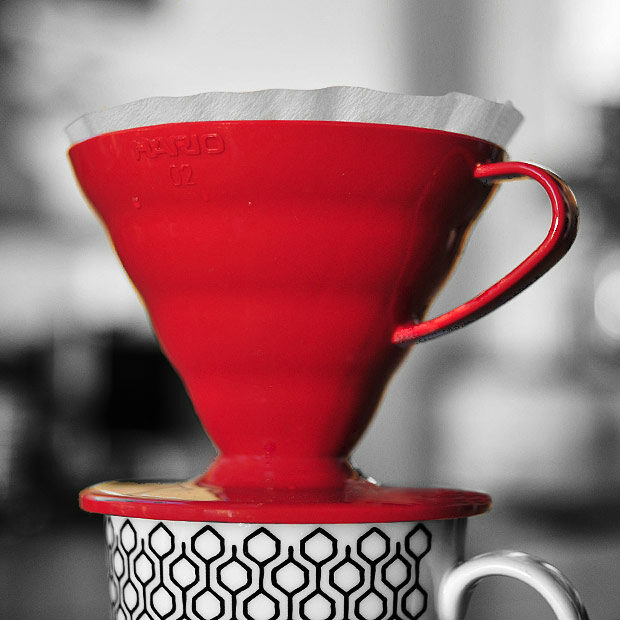
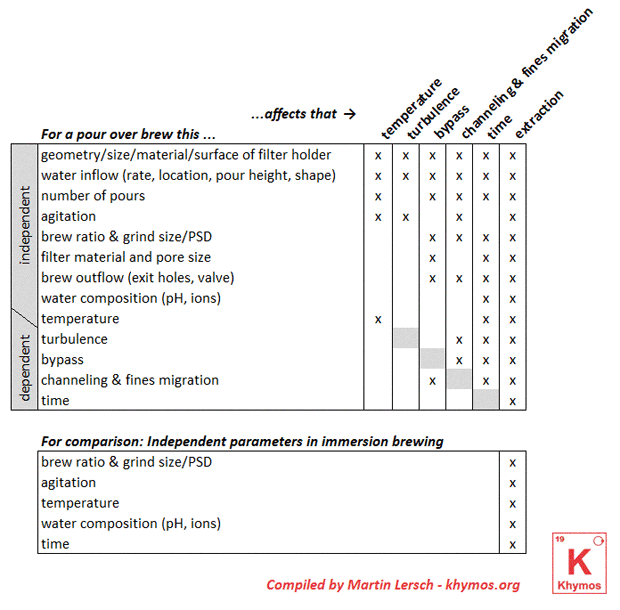
Pour-over brewing appears deceptively simple: hot water is introduced to a bed of ground coffee, filtering downward by gravity. However, a rigorous analysis reveals an intricate matrix of interdependent parameters. Variables such as brew ratio, particle size distribution (PSD), water composition, water temperature, filter material, and pore size directly dictate the final beverage.
Furthermore, these parameters are heavily correlated. Consider the role of grind size and particle size distribution. Finer grinds increase the total surface area available for extraction, which initially enhances flavor transfer. However, finer particles also impede water flow, extending contact time. This restricted flow introduces a critical vulnerability: channel formation. Water, acting along the path of least resistance, will frequently bypass the dense coffee bed entirely, routing instead through the sides of the filter where resistance is lowest. This phenomenon is exacerbated by equipment designs that encourage rapid fluid movement along the container walls.
The sheer complexity of these variables explains the proliferation of differing brewing techniques, yet it also highlights the limitations of standard recipes. Two individuals following identical instructions will rarely produce identical brews, primarily because conventional recipes fail to account for the full spectrum of physical variables at play.
Evolution of Brewer Design and Engineering
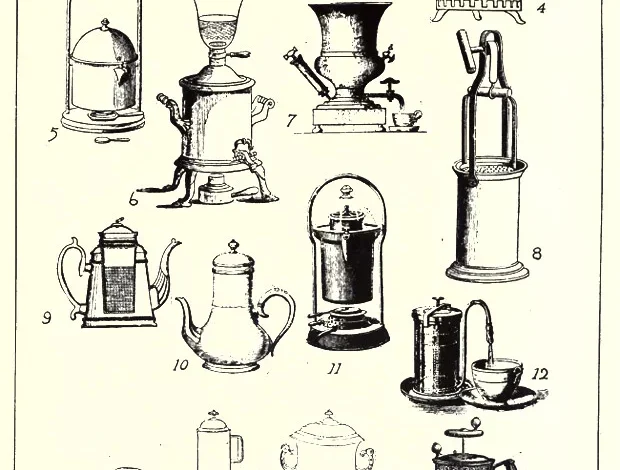
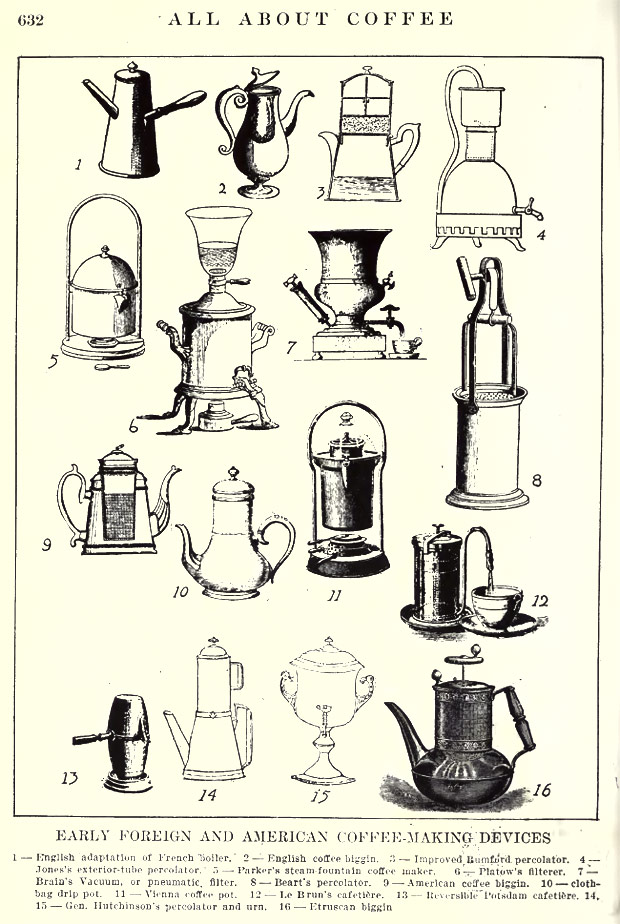
An exhaustive review of commercial coffee-making equipment reveals that inventors have spent more than a century attempting to resolve the inherent flaws of drip and pour-over systems. Historical records, such as W.A. Ukers’ comprehensive 1922 text All About Coffee, demonstrate that mechanical innovation in coffee brewing is centuries old. Modern manufacturers continue this tradition by modifying specific design metrics to optimize extraction.
Material and Thermal Dynamics
Thermal retention is paramount during extraction. Highly conductive metals rapidly dissipate heat unless engineered with vacuum insulation (such as the double-walled Stagg X/XF drippers) or constructed with immense thermal mass, as seen in commercial espresso portafilters. While glass offers thermal stability, its fragility makes it less than ideal for high-handling environments. Consequently, durable plastics—such as polypropylene—and ceramics remain industry standards for balancing cost, structural sturdiness, and thermal insulation.
Geometry and Surface Structures
Brewer geometry fundamentally alters the shape of the coffee bed. Traditional trapezoidal Melitta-style holders contrast sharply with cone-shaped drippers like the Hario V60 and flat-bottom brewers like the Kalita Wave. High, narrow cylindrical beds maximize coffee-to-water contact time but restrict flow, whereas flat beds accelerate flow while increasing the risk of fluid channeling.
Furthermore, interior wall architecture dictates whether filter paper clings to the brewer surface. Smooth-walled vessels, such as the Chemex, force the wet paper flush against the glass, virtually eliminating side-wall bypass. Conversely, ridged or patterned drippers use internal channels to maintain consistent peripheral liquid flow, sacrificing a degree of bypass control to prevent total filter clogging.
Inflow and Outflow Regulation
Uncontrolled water pouring disturbs the coffee bed, exacerbating channeling. Modern accessories like gooseneck kettles, Gabi Dripmaster units, or Melodrip screens mitigate this by diffusing water droplets evenly across the surface. At the exit stage, aperture size and valve mechanisms dictate draw-down speed. Devices equipped with shut-off valves—such as the Clever Dripper or Hario Switch—enable an initial immersion phase followed by a controlled percolation phase, decoupling contact time from grind size.
Comparative Analysis of Coffee Brewing Equipment
To benchmark pour-over systems against alternative methodologies, industry researchers categorize equipment based on material composition, thermal insulation, bed geometry, surface structure, filter type, bottom configuration, bypass susceptibility, and flow control mechanisms.
| Filter Holder | Material | Insulation | Side Shape | Structure | Filter Type | Bottom Configuration | Bypass | Inflow Control | Outflow Control |
|---|---|---|---|---|---|---|---|---|---|
| Aeropress | Plastic | Material | Straight | None | Plain | Flat (97 holes) | No | No | Pressure |
| April Pour Over | Ceramic | Material | Tapered | Ridge | Folded | Flat (Open/Ridged) | Yes | No | None |
| Chemex | Glass | Material | Tapered | None | Plain | Cone | No | No | None |
| Clever Dripper | Plastic | Material | Tapered | Ridge | Plain | Trapezoid (1 hole) | Yes | No | Stop Valve |
| French Press | Glass | Material | Straight | None | Metal | Perforated Mesh | No | No | Pressure |
| Kalita Wave | Metal/Glass/Ceramic | Material/None | Tapered | None | Folded | Flat (3 holes) | Yes | No | None |
| Stagg X/XF | Metal | Vacuum | Tapered | None | Folded | Flat (10 holes) | Yes | No | None |
| V60 | Plastic/Ceramic | Material | Tapered | Ridge | Plain | Cone | No | No | None |
The Alternative: Immersion Brewing and Its Trade-Offs
Given the endless complexities and potential for human error inherent in pour-over systems, many commercial and domestic operators favor immersion brewing methods for their superior repeatability. In an immersion setup—exemplified by the traditional French Press or full-immersion Aeropress techniques—coffee grounds steep entirely in water for a fixed duration.
Chemically, immersion brewing is a remarkably robust process. Because all water is introduced simultaneously and extraction approaches an equilibrium over time, recipes are easily replicated across different operators. Furthermore, because total dissolved solids (TDS) and extraction yield eventually plateau, extraction time becomes less sensitive to minor variations in grind size.
However, immersion methods introduce distinct trade-offs. Traditional French Press brewers utilize open wire-mesh filters, allowing micro-particles (fines) and suspended oils to pass directly into the final beverage. While these suspended solids contribute significant body and tactile texture, they
also introduce localized bitterness and leave a noticeable sediment at the bottom of the cup. While supplementary paper filtration can remove these fines, the resulting cup can occasionally taste muted compared to a clean percolation brew.
Broader Implications and Industry Outlook
The ongoing analysis of coffee extraction mechanics highlights a central tension in contemporary coffee culture: the balance between precise control and operational simplicity. While advanced pour-over drippers and precision water-distribution accessories offer baristas unprecedented mastery over extraction variables, their complexity introduces unintended variations that fuel preparation myths and inconsistency.
As coffee equipment manufacturers continue to innovate—fusing the controlled extraction of percolation with the robust repeatability of immersion—the industry moves closer to the theoretical ideal of maximum flavor clarity. Ultimately, whether utilizing a complex multi-valve dripper or a standardized immersion vessel, the scientific deconstruction of brewing ensures that the quest for the optimal cup remains grounded in empirical chemistry and meticulous engineering.