The transition from late summer to early autumn is increasingly marked by a commercial clash between seasonal realities and retail marketing calendars. While meteorological summer persists with high temperatures well into September, consumer goods markets frequently pivot months in advance toward autumn-themed products, winter apparel, and holiday decorations. This premature shift has sparked growing resistance among consumers who prefer to align their culinary and lifestyle habits with actual seasonal produce availability rather than artificial retail timelines. Culinary professionals and food writers have increasingly advocated for preserving the flavors of late summer—specifically peak-season produce such as tomatoes—against the encroachment of autumn-marketed commodities.

The Economics and Psychology of Seasonal Retail Creep
Retail marketing strategies have historically sought to extend shopping seasons to maximize revenue windows. In the food and apparel sectors, this phenomenon, commonly termed "seasonal creep," introduces products like pumpkin spice formulations and heavy woolen coats as early as August. According to retail market analysts, this practice leverages consumer nostalgia and novelty-seeking behavior, yet it often alienates a significant demographic of shoppers experiencing fatigue from accelerated holiday marketing.
Psychologists note that forcing seasonal transitions during unseasonably warm weather can induce cognitive dissonance, as consumers reconciling an 85-degree afternoon with autumnal advertisements feel rushed through temporal experiences. In response, a counter-movement among home cooks and culinary commentators emphasizes adherence to natural agricultural cycles. By focusing on perishable, late-summer staples like fresh tomatoes, home cooks maintain a connection to local agriculture and traditional foodways that resist commercial expedience.

Culinary Evolution: Reinventing Traditional Risotto
Amid these broader discussions on seasonal consumption, home cooking methodologies continue to evolve to meet contemporary demands for efficiency without sacrificing gastronomic quality. Traditional risotto preparation is notoriously labor-intensive, requiring standing over a stove for upwards of thirty minutes, constant stirring to release starches, and the continuous addition of warmed broth. However, modern culinary techniques have increasingly challenged these dogmatic requirements.
Culinary experiments demonstrate that oven-baked risotto methods yield results comparable to traditional stovetop preparation while significantly reducing active labor time. By utilizing precise liquid ratios, sealed Dutch ovens, and foundational flavor profiles derived from fresh ingredients rather than pre-made broths, home cooks can achieve the desired creamy texture with minimal intervention.

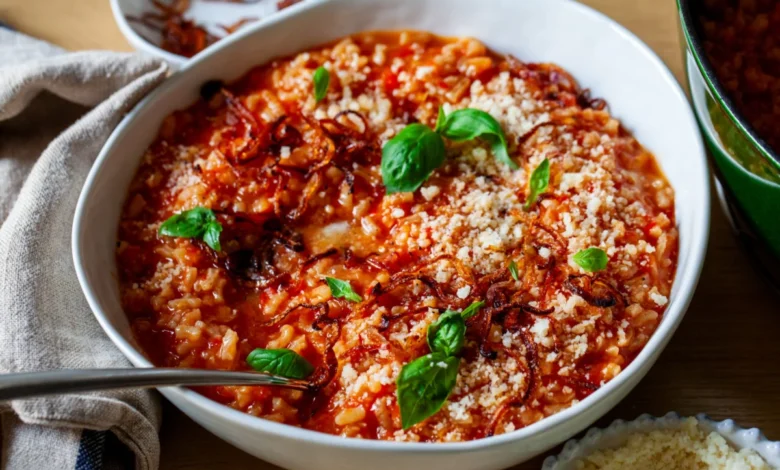
The adaptation of tomato risotto highlights this minimalist approach. Rather than relying on heavy fats, excessive quantities of parmesan cheese, or complex stock preparations, recipes increasingly highlight the intrinsic qualities of the primary ingredient. Utilizing grated fresh tomato pulp allows the short-grain rice to absorb concentrated, vibrant tomato flavors directly. Substituting water for meat or vegetable broths further isolates the pure flavor profile of the summer harvest, ensuring that the final dish remains light yet flavorful.
Recipe and Preparation Methodology: Tomato Risotto with Frizzled Red Onions
For home cooks seeking to execute this method, the process integrates modern oven-cooking techniques with traditional flavor balancing.

Ingredients and Preparation Parameters
- Primary Produce: Ripe tomatoes (halved and grated on a box grater to yield approximately 2.5 to 3 cups of pulp; outer skins discarded), short-grain rice, garlic, and red onions.
- Cooking Fats and Liquids: Olive oil, dry white wine, and water.
- Seasoning and Finishes: Kosher salt, freshly ground black pepper, red pepper flakes, butter or olive oil for finishing, parmesan cheese, and fresh basil leaves.
Step-by-Step Execution
- Oven Preheating: Heat the oven to 350°F (175°C).
- Onion Preparation: In a heavy-bottomed, 4-quart Dutch oven or oven-safe braiser with a lid, heat 3 to 4 tablespoons of olive oil over medium-high heat. Add thinly sliced red onions, stirring frequently until softened, then continue cooking until the pieces achieve a deeply golden brown color and crisp texture (approximately 8 to 10 minutes). Remove half of the onions, drain on paper towels, season with salt, and reserve.
- Aromatics and Rice Toasting: Add minced garlic to the remaining onions in the pan, cooking for approximately one minute. Season with salt, black pepper, and a pinch of red pepper flakes. Introduce the uncooked short-grain rice, allowing it to toast gently in the aromatic oil mixture for roughly 3 minutes.
- Deglazing and Liquid Integration: Pour in the white wine, stirring until evaporated. Add the grated tomato pulp and 2 cups of water. Season thoroughly with kosher salt (approximately 2 teaspoons to start) and black pepper. Bring the mixture to a brief simmer before removing from heat.
- Baking Process: Cover the Dutch oven with its lid and transfer it to the preheated oven. Bake for 25 to 30 minutes until the liquid is largely absorbed while retaining a slightly loose consistency. Monitoring the liquid level at the halfway mark is recommended; if absorption is proceeding too rapidly, an additional half-cup of water may be incorporated.
- Creaming and Finishing: Remove the pot from the oven and place it on a heat-resistant surface. Uncover and stir the mixture vigorously for approximately 2 minutes to encourage starch release and achieve a creamy texture. Adjust seasoning with additional salt and pepper if necessary. Stir in 2 to 3 tablespoons of butter or a high-quality olive oil.
- Garnishing: Scatter the reserved frizzled red onions across the top alongside torn fresh basil leaves and freshly grated parmesan cheese. Serve immediately.
Broader Implications for Modern Food Culture
The popularity of simplified, produce-forward recipes in late summer reflects a broader cultural shift toward mindful consumption. As supply chains globalize, consumers increasingly value hyper-seasonal eating as a method of grounding their diets in local temporal realities. Furthermore, the demystification of culinary techniques—such as disproving the necessity of constant stirring in risotto preparation—democratizes complex dishes, making them accessible to home cooks operating within constrained schedules.
As retail calendars continue to advance holiday cycles earlier into the calendar year, the kitchen remains a primary site of resistance for individuals seeking to maintain a direct relationship with natural agricultural rhythms. Through deliberate meal planning that prioritizes perishable summer produce, home cooks assert agency over their consumption habits, bridging the gap between historical culinary traditions and contemporary kitchen efficiencies.