The Evolution of Craft Beer: A Three-Decade Timeline of Defining Styles and Industry Shifts

Over the past thirty years, the global landscape of beer production has undergone a profound transformation. What began as a decentralized network of semi-obscure curiosities evolved into a recognized, resilient economic commodity. Crucially, this maturation occurred without the sector entirely surrendering its independent identity to corporate consolidation. While major conglomerates acquired select foundational brands, such as Goose Island, and others expanded into widespread national distribution, the true engine of the craft beer economy has consistently been driven by smaller regional players and cult labels. These independent entities continuously push the boundaries of flavor, pioneering unique profiles that challenge traditional brewing norms.
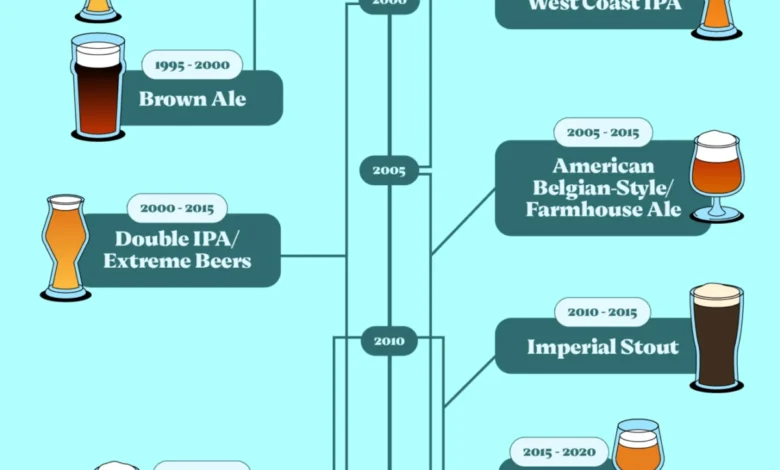
To understand the current state of the industry, one must examine the macro-trends that shaped consumer palates over the decades. Specific styles have repeatedly risen to prominence, capturing the attention of enthusiasts before either fading into obscurity or cementing themselves as permanent staples of the modern brewing lexicon. This retrospective explores the chronological rise, fall, and lasting stability of these defining craft beer styles, illustrating how consumer demand and brewer innovation co-evolved from the mid-1990s to the present day.
The Genesis of Craft: 1995 to 2000
The mid-to-late 1990s laid the structural foundation for the modern craft beer movement, characterized by an embrace of bolder, more assertive flavor profiles that contrasted sharply with the ubiquitous mass-produced American lagers of the era.
American Pale Ale
The American Pale Ale served as the foundational bedrock of the craft movement. Featuring a more potent, hop-forward profile highlighting citrus and pine notes derived from Pacific Northwest hop varieties, this style was a direct evolution of traditional, lower-ABV English pale ales. Although pioneering labels like Sierra Nevada Pale Ale were initially brewed as early as 1980, widespread public adoption took more than a decade. By the late 1990s, consumer obsession with hop-forward profiles took hold, paving the way for later interpretations such as Oskar Blues Brewery’s Dale’s Pale Ale. This era marked the first time mainstream consumers actively sought out specific hop profiles and regional brewing techniques, signaling a permanent shift in American drinking habits.
Hefeweizen
Originating in Bavaria in the early 16th century, the Hefeweizen was far from a modern invention when it achieved darling status in the mid-1990s. However, the cloudy, high-wheat-content ale was largely novel to the average American consumer. Pioneering domestic producers, including the Widmer Brothers and Pyramid Breweries, introduced the style to a domestic audience seeking sessionable yet flavorful alternatives to macro-lagers. Characterized by banana and clove notes imparted by specialized Bavarian yeast strains, the crisp, refreshing profile allowed the Hefeweizen to maintain commercial relevance for nearly two decades.
Brown Ale
The brief surge of the brown ale in the late 1990s represents a uniquely collaborative phenomenon between domestic craft producers and traditional imports. While American craft labels like Pete’s Wicked Ale popularized sweet, malt-forward interpretations domestically, the British import Newcastle Brown Ale also experienced a surprising renaissance in the United States even as its popularity waned in its home market. This duality introduced consumers to malt-centric brewing traditions, though the style’s market dominance proved short-lived as palates shifted toward more aggressive bitterness.
The Expansion of Flavor: 2005 to 2015
As consumers grew comfortable with foundational craft styles, the industry entered an era of rapid experimentation, marked by geographic stylistic divides and an escalation of alcohol by volume (ABV) and hopping rates.
Amber Ale and the West Coast IPA
For approximately a decade spanning the late 1990s and early 2000s, the amber ale acted as a crucial bridge between mainstream domestic lagers and the increasingly esoteric craft sector. Offering a subtly bittersweet profile that balanced malt sweetness with moderate hop bitterness, it provided a comfortable middle ground for curious drinkers.
Simultaneously, the West Coast IPA emerged to fundamentally alter the trajectory of the industry. Spearheaded by aggressive iterations from breweries such as Lagunitas and Stone Brewing, the West Coast IPA introduced an assertive, highly bitter, dank, and resinous profile that pushed past the boundaries of traditional pale ales. Despite subsequent market fragmentation caused by newer IPA sub-categories, the West Coast style remains the baseline definition of the IPA for casual consumers.
Extreme Beers and Double IPAs
Entering the 2000s, a segment of the craft brewing industry engaged in a stylistic arms race, pushing the limits of bitterness, malt density, and alcohol content. The resulting Double IPAs and "extreme beers" routinely featured ABVs exceeding those of standard table wines. Industry analysts noted that these products largely thrived on novelty and intensity, capturing consumer interest through sheer sensory overload rather than subtle balance.
American Belgian-Style and Farmhouse Ales
While Trappist brewing traditions in Belgium had long commanded a dedicated global following, their high price points and complex production methods limited their accessibility. Domestic craft pioneers such as Allagash Brewing Company and Brewery Ommegang resolved this by marrying traditional Belgian yeast strains with American agricultural ingredients. This innovation not only captured mass consumer appeal but also birthed the domestic farmhouse ale and wild ale subcategories, establishing a resilient retail presence that persists today.
Imperial Stouts
By the end of the 2000s, industrial stouts had largely lost their intimidating reputation among mainstream consumers. Imperial stouts reset this dynamic by exponentially increasing the viscosity, roast, and alcohol content of traditional stouts. Delivering pronounced flavor notes of dark chocolate, espresso, and roasted barley, these high-ABV offerings became collector items, laying the groundwork for the decadent pastry stout trends of the following decade.
The Era of Diversification and Specialization: 2010 to Present
The modern era of craft brewing is defined by hyper-specialization, technological innovations in brewing equipment, and a simultaneous bifurcation between ultra-sweet dessert beers and a return to crisp, traditional lagers.
Niche IPA Substyles
Beginning in the 2010s, the IPA category fractured into numerous niche substyles. The Black IPA combined the visual aesthetic of a stout with the hop profile of an ale, while Session IPAs targeted health-conscious consumers seeking lower alcohol content without sacrificing hop aroma. Conversely, styles like Brut IPAs and Milkshake IPAs pushed technical boundaries through enzyme usage and the incorporation of lactose and fruit, testing the limits of consumer acceptance.
Barrel-Aged Beers
In the mid-2015s, the practice of aging high-gravity ales in used wine and spirits casks transitioned from an esoteric hobby to a major prestige sector. By housing stouts, barleywines, and strong ales in bourbon or sherry barrels for periods ranging from months to years, brewers created complex products featuring notes of oak, vanilla, and residual spirits. Despite commanding high retail price points, barrel-aged releases successfully positioned craft beer as a luxury artisanal product comparable to fine wine or aged spirits.
Hazy IPAs
Originally popularized as a regional cult style in the Northeast United States—commonly referred to as New England IPAs—hazy IPAs revolutionized the market in the mid-2010s. Characterized by their opaque appearance, low bitterness, and intense tropical fruit aromatics derived from heavy dry-hopping techniques, these beers resonated strongly with contemporary consumer aesthetics. Their proliferation was heavily accelerated by social media visibility, eventually establishing them as a permanent fixture on tap lists nationwide.
Sours and Pastry Stouts
The latter half of the 2010s saw polar opposite extremes dominate taproom sales: tart, fruit-infused sour beers and ultra-sweet pastry stouts. Sours revived historical brewing traditions like Gose, Berliner Weisse, and Lambic, transforming them into brightly colored, highly acidic treats, which eventually birthed viscous smoothie-style beers. Concurrently, the pastry stout movement treated breweries like commercial bakeries, utilizing adjuncts such as cacao nibs, vanilla beans, and toasted coconut to emulate desserts. Industry experts note that while these styles have experienced a decline from their peak popularity, they retain intensely loyal consumer bases.
Return to Tradition: Italian, Mexican, and Czech Lagers
Entering the 2020s, a distinct market correction occurred, favoring clean, highly drinkable, low-ABV lagers over high-gravity or heavily adulterated styles. The rise of the Italian Pilsner—pioneered by breweries like Firestone Walker through dry-hopped European varietals—signaled a renewed appreciation for structural balance.
This momentum extended to Mexican-style lagers, which gained traction both as a post-pandemic consumer preference for refreshing, uncomplicated beverages and as a nod to traditional flaked-corn brewing adjuncts. Most recently, the resurgence of Czech-style lagers utilizing traditional Bohemian brewing methods and specialized Lukr side-pull faucets highlights a full-circle movement within the industry. Today, consumers increasingly value pristine foam heads, traditional decoction mashes, and unpretentious flavor profiles, proving that after three decades of radical experimentation, the ultimate hallmark of a successful craft beer is simply exceptional execution of a timeless classic.