The Chemistry of the Brew: Unlocking the Complex Molecular Composition Inside a Cup of Coffee

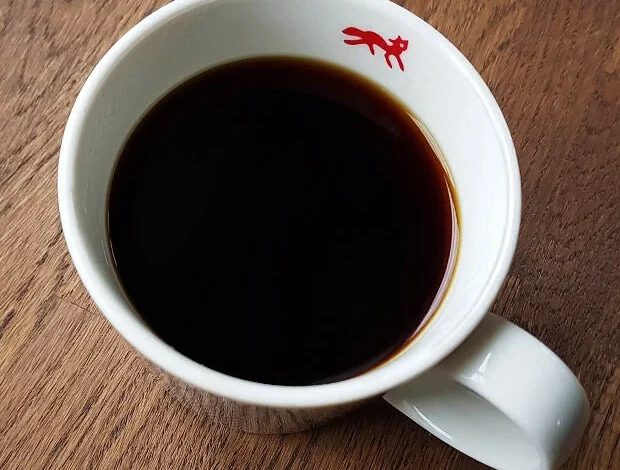
When a consumer pours a standard cup of black coffee, the visual and physical appearance suggests a simple, uniform liquid. In reality, that morning brew is a remarkably complex chemical matrix composed of thousands of individual molecules working in concert. While water accounts for more than 98.5 percent of the beverage, the remaining fraction—known scientifically as Total Dissolved Solids (TDS)—holds the entire sensory profile of the drink. Typically ranging between 1.2 and 1.5 percent, these dissolved solids mean that a single liter of brewed coffee contains roughly 12 to 15 grams of material extracted from approximately 60 grams of roasted coffee grounds.
Understanding what actually exists inside that cup requires a deep dive into food science, analytical chemistry, and the physics of extraction. Recent advancements in chromatographic techniques and gas chromatography-olfactometry have allowed flavor chemists to peer deeper into the composition of coffee than ever before, revealing a microscopic landscape that rivals the complexity of fine perfumes and rare wines.
The Anatomy of Extraction: Volatiles, Non-Volatiles, and Polar Compounds
The compounds extracted during the brewing process are broadly categorized into volatile and non-volatile components, each playing a distinct role in how humans experience the beverage. Volatile compounds easily transition into the gas phase, rising from the cup to enter the nasal passages and deliver the rich, distinct aroma associated with coffee. Conversely, non-volatile compounds remain in the liquid phase, interacting directly with taste receptors on the tongue to provide fundamental tastes such as bitterness, sweetness, acidity, and astringency. Furthermore, non-volatile lipids and microscopic insoluble particles contribute significantly to the mouthfeel, weight, and body of the coffee.
Chemically, these elements can also be separated into polar and non-polar groups. Polar compounds—including various organic acids, minerals, soluble carbohydrates, and proteins—share an affinity for water. As a result, water acts as an efficient polar solvent, capable of extracting more than 75 percent of the available polar compounds during a standard brew cycle.

On the other side of the spectrum are non-polar compounds, which include essential aromatic volatile molecules and hydrophobic lipids. Because water is a poor solvent for non-polar substances, only 10 to 30 percent of these compounds typically find their way into a standard cup of brewed coffee. This chemical limitation has led advanced food scientists to explore alternative solvents, such as ethanol, to unlock entirely new dimensions of flavor extraction that remain inaccessible to water alone.
Chronology of Coffee Chemistry Breakthroughs
The scientific quest to decode the exact chemical makeup of coffee is not a recent endeavor; it spans decades of meticulous analytical research.
- 1960s: Flavor chemists first discover rose ketones—a powerful family of aromatic compounds—within natural rose oil. These compounds would later prove to be pivotal not only in high-end perfumery, such as Christian Dior’s iconic Poison fragrance, but also in the subtle aromatic profiles of roasted coffee.
- 1996: A landmark study published by researchers P. Semmelroch and W. Grosch in the Journal of Agricultural and Food Chemistry successfully identified 22 key volatile compounds in coffee. Using these compounds, the researchers synthesized two "model" coffees designed to mimic Arabica and Robusta beans. While human assessors described the synthetic models as "clearly coffee-like," the experiment proved that 22 compounds were fundamentally insufficient to replicate the deep complexity of natural coffee.
- 2002: An Aroma Extract Dilution Analysis (AEDA) led by C. Sanz and colleagues pushed the boundaries of coffee research further. The analysis revealed that out of 40 key odorants identified in coffee, an astonishing 13 molecules remained completely unknown to science, largely due to their minuscule concentrations or massive molecular structures.
- 2016–2020: Modern studies published in journals such as Food Research International and the Journal of the Science of Food and Agriculture continued to refine extraction models, shedding light on how brewing parameters alter the concentration of specific carbohydrates, acids, and aromatic precursors.
The Power of Trace Elements: Odor Activity Values
One of the most counterintuitive findings in modern flavor chemistry is that concentration does not strictly equate to sensory impact. While it is tempting to assume that molecules present in higher amounts dictate the flavor profile, human sensory biology operates on a much more nuanced scale.
Every chemical compound possesses a unique odor threshold—the minimum concentration at which the human nose can detect its presence. Flavor scientists utilize the Odor Activity Value (OAV), calculated by dividing a compound’s actual concentration by its odor threshold, to determine its true sensory weight.
A prime example of this phenomenon is $beta$-damascenone, a prominent member of the rose ketone family. Found in coffee at concentrations as low as one part per trillion (ppt)—expressed as 0.0000000001% of the beverage—$beta$-damascenone exerts a massive influence on the overall flavor profile. Chromatographic and olfactory studies consistently rank it among the top five most impactful odorants in coffee. This demonstrates that a chemical present in infinitesimal trace amounts can be just as crucial to the sensory experience as a macronutrient compound present at a concentration millions of times higher.
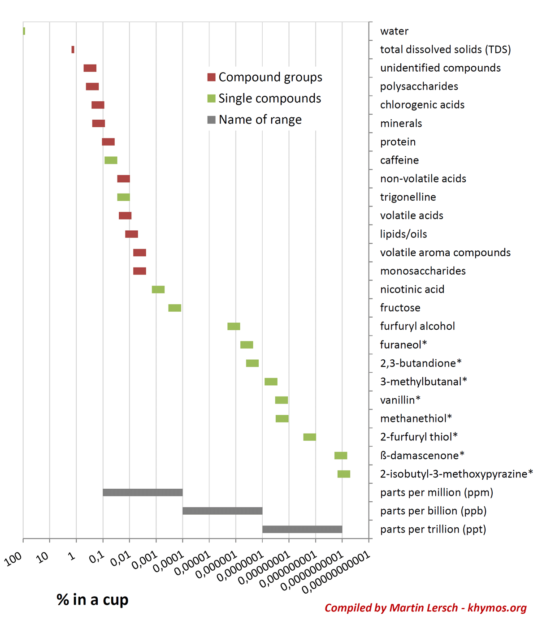
Because measuring these trace thresholds requires exhaustive, painstaking laboratory work, food scientists and analytical chemists anticipate that additional key odorants in coffee will be discovered as detection technology grows more sensitive.
Limitations of Traditional Strength Metrics
For decades, both commercial coffee shops and home enthusiasts have relied on Total Dissolved Solids (TDS) as the gold standard for measuring coffee strength. Refractometers can quickly determine the percentage of dissolved matter in a brew, offering immediate feedback on extraction efficiency.
However, industry experts and researchers emphasize that TDS is an incomplete metric. While TDS measures the quantity of dissolved solids, it fails to capture quality or aromatic composition. Because different chemical families—such as polar acids versus non-polar aromatics—extract at vastly different rates and efficiencies, two cups of coffee with identical TDS readings can taste entirely different. A high TDS measurement does not reliably predict whether a cup will be balanced, overly bitter, or lacking in aromatic complexity.
Consequently, while instruments remain valuable for quality control and process repeatability, the human nose and palate remain the ultimate analytical detectors. As researchers continue to map the thousands of known and unknown molecules residing within the humble coffee bean, the journey of understanding how extraction parameters translate into sensory delight remains an ongoing intersection of art, physics, and advanced chemistry.