Unearthing Melaka’s Culinary Heritage: The Century-Old Tradition of Hainanese Chicken Rice Balls at Kedai Kopi Chung Wah

The historic coastal city of Melaka, Malaysia, recognized globally as a UNESCO World Heritage site, is celebrated not only for its rich colonial architecture and centuries-old multicultural tapestry, but also as a premier culinary destination in Southeast Asia. Among the myriad gastronomic offerings that draw international travelers to this region, Hainanese chicken rice stands out as an iconic staple. However, within Melaka’s bustling historic district, this ubiquitous dish is given a unique local interpretation that has captivated food historians, culinary tourists, and local residents alike for generations: the Hainanese chicken rice ball. At the epicenter of this culinary tradition is Kedai Kopi Chung Wah, a family-run heritage establishment situated on the corner of Jonker Street, where the meticulous preparation of hand-rolled rice spheres continues to draw daily queues and international acclaim.
Historical Context and Cultural Origins of Hainanese Chicken Rice
To understand the significance of Kedai Kopi Chung Wah, one must examine the broader historical migration patterns that shaped Southeast Asian cuisine. Hainanese chicken rice traces its origins to the island of Hainan in southern China, where local cooks prepared a dish known as Wenchang chicken, served alongside plain white rice cooked in poultry broth. During the 19th and early 20th centuries, waves of immigrants from Hainan migrated across the South China Sea, settling in British Malaya, Singapore, and Thailand.
Upon arrival, these immigrants adapted their traditional recipes to local ingredients and available resources. In Melaka, the adaptation took a particularly ingenious form: the transformation of loose grains of rice into compact, spherical balls. Historical food accounts indicate that this practice originated out of necessity. Early Hainanese laborers, hawkers, and travelers required portable, enduring meals that could be easily transported into the hills or fields for picnics and long workdays. Compressing the hot, chicken-broth-infused rice into tight balls allowed the food to retain its heat longer, remain structurally sound during transport, and serve as a convenient, nutrient-dense ration. Over decades, what began as a practical packing method evolved into a cherished regional specialty unique to Melaka and select parts of the Malay Peninsula.
The Culinary Anatomy of Kedai Kopi Chung Wah
Operating daily from its prominent location just across the flower-adorned bridge facing Jonker Street, Kedai Kopi Chung Wah exemplifies the preservation of traditional culinary techniques. The establishment’s workflow is a study in industrial efficiency honed by decades of operation. Upon arrival, patrons navigate the notoriously high volume of foot traffic—often waiting in queues that form well before the restaurant’s 9:00 AM opening time—to secure a table.
The ordering system is remarkably streamlined to accommodate the relentless rush. Waitstaff assess party sizes to determine the appropriate allocation of rice ball plates, while diners specify whether they require half or whole portions of poached chicken. Within minutes, steaming dishes are delivered to the tables, reflecting a high-turnover dining culture that prioritizes rapid service over lingering leisure.

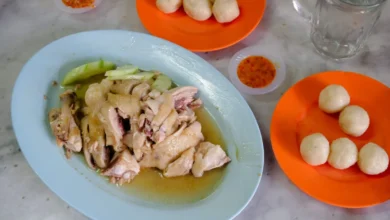
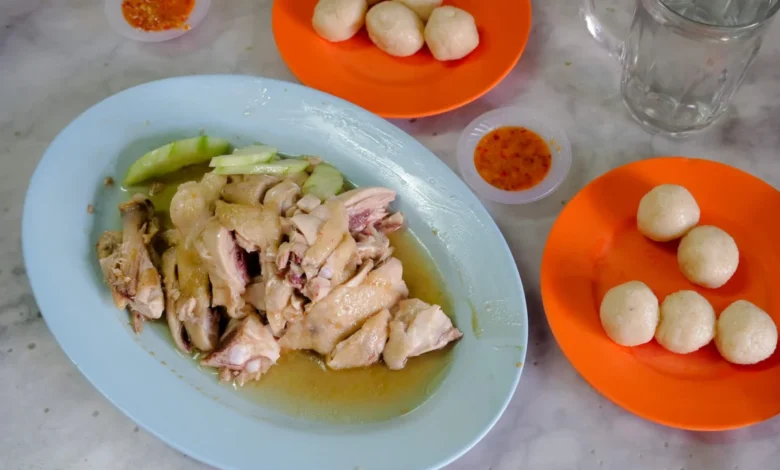
The meal consists of three primary components, each requiring exacting preparation:
The Chicken: Poached to a precise internal temperature to ensure tenderness, the chicken is served immediately while steaming hot. The skin remains velvety and soft, infused with subtle aromatic notes of garlic and a gentle, savory undertone characteristic of traditional Chinese-Malaysian preparation methods.
The Dipping Sauce: Culinary analysts frequently note that the accompanying dipping sauce elevates the dish from standard fare to an exceptional gastronomic experience. Departing from standard ginger-scallion pastes, the restaurant utilizes a vinegar-heavy, garlic-laden formulation that delivers a distinct acidic punch, balanced by a sharp, localized chili heat. This fusion bridges the culinary divide between traditional southern Chinese poaching methods and bold, Malay flavor profiles.
The Rice Balls: The signature offering—the rice balls—distinguishes Chung Wah from standard chicken rice vendors. The rice is cooked in rich chicken stock rendered from poultry fats, garlic, ginger, and pandan leaves. While still hot, the rice is firmly compressed by hand into dense, uniform spheres. The resulting texture is dense yet pliable, possessing a firm exterior that holds its spherical shape even when nudged across the plate. The grains exhibit a distinct smoky aroma and a texture reminiscent of the prized, slightly crisped bottom layer of rice from a traditional cooker, though achieved uniformly throughout the ball.

Socioeconomic Impact and Tourism Significance
Melaka’s tourism economy relies heavily on cultural and culinary heritage. Since the 15th century, the Straights of Malacca have served as a vital maritime trade route, attracting merchants from China, India, the Middle East, and Europe. This historical convergence created the distinct Peranakan (Straits Chinese) and Nyonya cultures, which heavily influence modern Melaka. While Hainanese chicken rice is strictly speaking a Chinese immigrant contribution rather than a native Peranakan dish, it has been seamlessly integrated into Melaka’s multicultural identity.
Gastronomic tourism experts note that establishments like Kedai Kopi Chung Wah function as living museums. By maintaining manual preparation methods—refusing to mechanize the labor-intensive rolling of rice balls—the proprietors preserve intangible cultural heritage in the face of rapid modernization. Furthermore, the economic footprint of such legacy eateries extends to surrounding local vendors, suppliers of poultry, and the broader hospitality sector of Jonker Walk, driving weekend tourist surges from Kuala Lumpur, Singapore, and beyond.
Operational Realities and Practical Information for Visitors

Navigating a visit to Kedai Kopi Chung Wah requires strategic planning due to its immense popularity and physical constraints.
Location and Access: Situated at the bridgehead of Jonker Street in Melaka, the establishment is easily accessible on foot for visitors exploring the historic city center. However, vehicular access and parking in the immediate vicinity remain notoriously challenging, with ambiguous road markings frequently confusing motorists unfamiliar with local traffic layouts.
Operating Hours: The restaurant opens promptly at 9:00 AM daily, closing at 3:00 PM on weekdays and 4:00 PM on weekends, or earlier should the daily supply of chicken and rice balls sell out.
Pricing Structure: Reflecting its traditional hawker-style roots, the pricing remains highly accessible. Standard meals for small parties average approximately 28 Malaysian Ringgit (approx. US$6.77), making it an economically viable option for budget travelers and culinary explorers alike.
Dining Etiquette: Due to the high volume of patrons waiting in line, dining at Chung Wah is brisk. It is customary for one member of a dining party to secure seating while another places the order at the counter. Extended lingering is generally discouraged to facilitate table turnover for incoming guests.
Broader Culinary Horizons in Regional Malaysia
For travelers seeking to expand their culinary exploration beyond Melaka’s urban center, food critics and regional tourism boards recommend venturing further north to the states of Kelantan and Terengganu along Malaysia’s northeastern coast. This region offers a distinct culinary landscape heavily influenced by Thai traditions and coastal geography, featuring unique preparations such as Nasi Kerabu (blue herb rice) and Tempoyak (fermented durian paste used in savory curries).

Nevertheless, Kedai Kopi Chung Wah remains an indispensable touchstone for those examining the evolution of Chinese diaspora cuisine in Southeast Asia. Through its unwavering commitment to traditional recipes, precise execution, and historical continuity, the establishment offers a tangible link to the past—one hand-rolled rice ball at a time.
Related posts: