Amedeo Avogadro’s 250th Birthday Celebrated With the Launch of a Parametric Waffle Recipe Generator

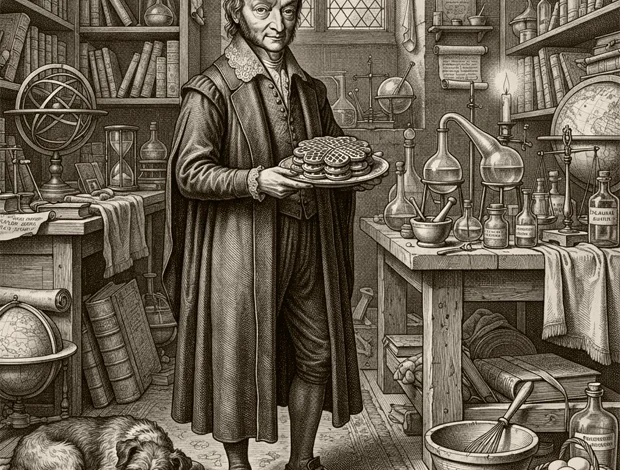
The intersection of computational gastronomy and historical scientific commemoration has yielded an unusual digital artifact: a parametric waffle recipe generator named in honor of physicist and chemist Amedeo Avogadro. Released to coincide with the 250th anniversary of Avogadro’s birth on August 9, 1776, the new web application attempts to codify the elusive culinary physics behind the traditional Scandinavian heart-shaped waffle. Developed by culinary science communicator and researcher Martin Lersch, the tool—appropriately titled Avogadro—bridges the gap between centuries-old baking traditions and modern algorithmic ingredient modeling.
Main Facts and Technological Architecture
Unlike conventional online recipe repositories, the Avogadro generator operates entirely without a database. It does not store or retrieve pre-written formulas. Instead, users interact with a real-time parametric modeling engine. Bakers select fundamental ingredient categories—encompassing liquids, dairy products, fats, eggs, starches, and sweeteners—and adjust a series of interactive sliders that dictate specific structural and sensory properties, including sweetness, richness, and tanginess.
Upon any adjustment, the application calculates a precise batter formulation on the spot, scaling ingredient weights in grams relative to the number of eggs selected by the user. A central diagnostic feature, known as the waffle heart quality indicator, provides immediate visual feedback. This indicator serves a dual purpose: it verifies whether the generated batter possesses the physical properties necessary to cook successfully, and it evaluates how typical the composition is when compared against an empirical dataset of approximately 1,000 authentic Norwegian and Scandinavian waffle recipes collected over years of research.
The platform accommodates users through two distinct operational interfaces: standard mode and expert mode. Standard mode simplifies the culinary engineering process by utilizing a curated subset of ingredients and a restricted number of sliders, ensuring that any generated combination yields a functional, crowd-pleasing batter. Conversely, expert mode opens the full architecture of the tool, granting access to the comprehensive ingredient library, eight independent control sliders, and advanced presets. This granular level of control allows culinary enthusiasts to explore uncharted regions of batter composition that standard cookbooks have historically omitted.
Chronology and Development History
The conceptual origins of the Avogadro generator date back more than a decade. The project began as a theoretical notion in 2014, when Lersch initially outlined the foundational logic, created rudimentary visual mockups, and constructed a basic spreadsheet model to test the feasibility of parametric batter scaling. However, technological constraints, competing projects, and the complexity of mathematically defining traditional culinary intuition caused the initiative to stall.

The project remained dormant for twelve years until a convergence of motivations revived it for the physicist’s milestone anniversary. August 9, 2026, marked precisely two and a half centuries since Avogadro’s birth in Turin, Italy. Recognizing the numerical symmetry between the scale of possible control settings within the application and Avogadro’s foundational contributions to molecular chemistry, development resumed in earnest to meet the mid-2026 launch deadline. The resulting software successfully transitions the 2014 Excel concepts into a responsive, live-updating web environment.
Mathematical Scaling and Supporting Data
The platform derives its name and launch date from the sheer magnitude of its combinatorial potential, which pays homage to Avogadro’s constant. In chemistry, Avogadro’s number—approximately $6.022 times 10^23$—denotes the number of constituent particles, such as molecules or atoms, contained in one mole of a substance.
By calculating every permutation of ingredient selections and slider positions, the Avogadro generator yields approximately $10^27$ distinct control settings. This astronomical figure implies that the tool’s theoretical design space encompasses roughly 1,660 moles’ worth of unique waffle batter formulations.
Despite the vastness of this theoretical landscape, the developer emphasizes important empirical caveats regarding the data. The existence of $10^27$ control settings does not translate to an equivalent number of meaningfully distinct recipes. System rounding protocols and the automated pruning of trace ingredients mean that numerous distinct control configurations ultimately resolve to identical batter compositions. Furthermore, certain parameter extremes land well outside the realm of practical food science, resulting in dysfunctional batters explicitly flagged by the absence of lobes in the application’s quality indicator. Nevertheless, the vast parameter space ensures that users experimenting with the interface can readily discover entirely novel recipes that have never before been documented in culinary literature.
Historical Context and Traditional Knowledge
The conceptual challenge that inspired the Avogadro generator lies in the nature of historical culinary documentation. Traditional Scandinavian waffle recipes frequently relied on tacit knowledge, utilizing qualitative instructions such as "add flour until the batter has the right consistency." Such unwritten culinary physics relied heavily on the baker’s sensory experience, making them absent from standardized recipe corpuses.
By analyzing approximately 1,000 traditional Scandinavian recipes, the project attempts to answer a fundamental question in food science: What empirical boundaries define a functional waffle batter, and at what point does a mixture cease to function as one? Older texts omitted exact measurements because consistency was paramount, a variable that modern home cooks often struggle to replicate without standardized metrics. The Avogadro application acts as a digital proxy for this historical tacit knowledge, translating qualitative descriptions of "right consistency" into quantifiable, replicable mass ratios.

Broader Impact and Industry Implications
The release of the Avogadro generator highlights a broader trend within food science and domestic cooking: the parametric modeling of traditional foods. By shifting the paradigm from static recipe execution to dynamic formula generation, tools of this nature challenge traditional notions of culinary authenticity.
Interestingly, the application’s quality indicator reveals that several commercially successful, pre-packaged waffle mixes sit surprisingly far outside the statistical norms established by traditional home-cooking recipes. This divergence suggests that commercial formulations prioritize shelf-stability, manufacturing efficiencies, and broad consumer appeal over historical compositional norms, yet still produce culturally acceptable results.
Furthermore, the launch serves as a crowdsourced scientific experiment. Because testing $10^27$ distinct batters empirically is an impossible undertaking, the developer has positioned the application as an open-ended research tool. By inviting the global culinary community to test boundary conditions, report algorithmic anomalies, and share successful novel formulations, the platform establishes a feedback loop designed to refine the underlying mathematical model of batter behavior.
As home cooks and food scientists engage with the platform to celebrate Amedeo Avogadro’s 250th birthday, the project demonstrates how computational tools can preserve, analyze, and expand upon centuries of empirical domestic science.